Weapon Engineer Officer
Skip to section:
About the role Career progression and training Salary and benefits Entry requirementsAs a Weapon Engineer Officer you will be one of the Navy’s weapon, communication, sensor and combat management system experts.
- ServiceNavy
- SpecialisationEngineering and Technical Trades
- LocationDevonport
-
Starting Trade Training$65,075
About the role
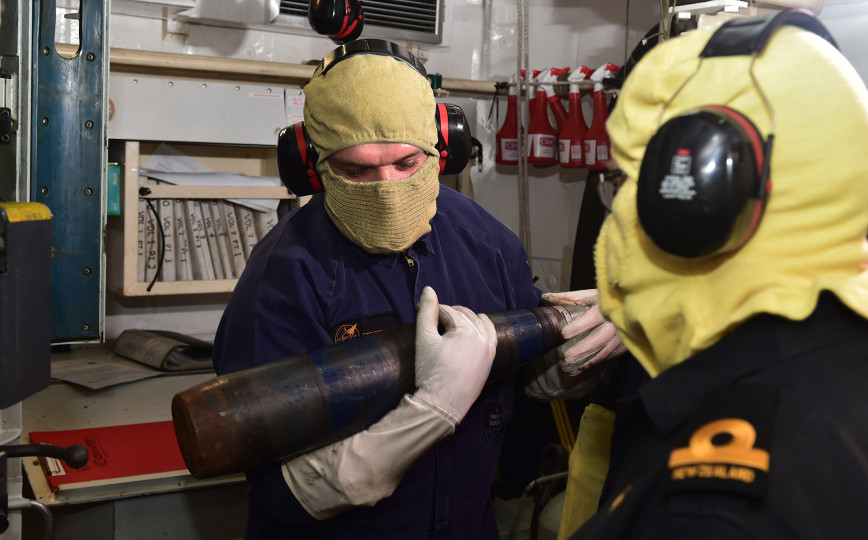
As a Weapon Engineer Officer you will become an expert in the Navy’s weapon, communication, sensor and combat management systems.
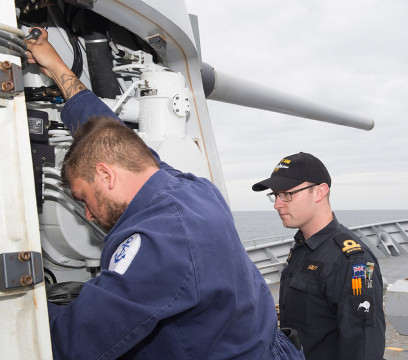
Onboard a ship you will lead a team of skilled technicians who maintain and repair the sophisticated equipment that provides our Navy’s fighting capability. Information Technology is key in your area of work, however a diverse range of systems will be under your charge.
Leadership and effective communication in a multi-disciplinary environment will be your key qualities. You are also likely to be a logical thinker who works well with people and seeks a challenging work environment.
Job on base
In shore based positions, generally in Devonport Naval Base (Auckland), Weapon Engineers perform duties in support of the fleet. You are responsible for the procurement and through-life support of our ships, as well as the training and management of our officers and sailors.
A diverse range of positions are available such as project management, equipment procurement and upgrades, system performance analysis and maintenance planning. Your career will be managed so that you rotate regularly through these roles, ensuring you develop a broad understanding of weapon and combat systems engineering tasks. Further specialist training will be provided in fields such as project management, to ensure you have all the skills required for the job.
Job on deployment
Onboard a ship, once you’re fully qualified you will lead the Weapon Engineering Department – a team of up to 31 skilled technicians.
You will be responsible directly to the Commanding Officer for the performance and availability of the equipment under your charge and the welfare and training of the people under your leadership.
You will hold a senior position onboard and will work closely with the other members of the senior leadership team to achieve the ship’s objectives.
.
Tactical problem solving, tinkering and leading from the front are my three passions.
Keith Cook

Career progression and training
Career Progression
Basic Training
Job Training
Ongoing Training
After graduating JOCT and a minimum of six months experience onboard a ship, you will move to the Royal Navy’s Maritime Warfare School near Portsmouth, UK. Here you’ll complete the Systems Engineering and Management Course (SEMC), learning the principles of weapon engineering and the management of a ship’s engineering department.
The next phase of your career will be on-the-job training conducted under the supervision of a senior Weapon Engineer. You will be mentored to achieve the Weapon Engineer Officers’ Charge Qualification (WCQ), which indicates you have the theoretical and practical knowledge required to take sole charge of a ship’s Weapon Engineering Department.
You will then rotate through various shore based engineering positions every 18 to 24 months, to broaden your skills before returning to sea as the senior Weapon Engineer. You will be offered continuous internal and external training opportunities for professional development. You will be able to complete your Masters degree, and you'll benefit from a streamlined route to becoming a Chartered Engineer.
Junior Officer Common Training (JOCT)
(21 weeks) Location: Devonport Naval Base
The objective of JOCT is to provide you with the core skills of military, mariner, and leadership to be an effective Officer in the Navy. The course is completed in two phases of training that train key areas of development.
Phase 1 – Introduction
This phase focuses on ‘followership’ and teamwork. Trainees are instructed in basic service knowledge, discipline, parade, and kit preparation. Physical Training will be conducted at all times throughout training to develop a high level of physical and mental fitness that promotes morale, good health, and good habits. This phase will cover various topics including:
- Physical Fitness
- Service Knowledge
- Service Discipline
- Introduction to the Leadership Development Framework
- Damage Control Training
- Weapons Training
- First Aid
- Basic seamanship training
- Moving to advanced application
Phase 2 – Fit for Sea
The second phase of training will focus on attributes of being in the Navy in preparation for operational service at sea. Trainees will be taught about the roles and responsibilities on board an RNZN ship. Trainees will also spend time ashore conducting academic and leadership training to further develop as a Naval Officer. This phase will cover various topics including:
- Sea survival
- Ship familiarisation
- Leadership training
- Communications skills
- Defence and Strategic Studies
On completion of JOCT, those without tertiary engineering qualifications will be sponsored through a scheme to complete either a Bachelor of Engineering (Honours), a Bachelor of Engineering Technology or similar degree. If you join with a tertiary engineering qualification, you’ll be promoted to Sub-Lieutenant, and usually start the next available SEMC.
Systems Engineering and Management Course (SEMC)
(6 months) Location: Defence School of Weapon Engineering, Portsmouth, UK.
The SEMC is a professional application training course in Naval Weapon Engineering, which will complement your academic training and prepare you for the next step of your professional development. The course covers weapons engineering theory and practice, before you return to New Zealand and gain practical experience in charge of the operation of relevant systems.
SEMC training is recognised as professional development towards registration as a Chartered Engineer.
On completion of SEMC you will be posted to a Royal New Zealand Navy Ship to gain further skills and experience necessary to manage the entire Weapon Engineering Department. During this time you will be supervised and mentored by the senior Weapon Engineer Officer onboard.
Once you have achieved the required qualifications you will be promoted to Lieutenant. The Navy supports Weapon Engineer Officers to become Chartered Engineers, and there is also a Masters programme available through the University of Portsmouth.

Salary and benefits
Careers in the Navy are well-rewarded, as well as being diverse and exciting. As you become more experienced and move up through the ranks, gaining additional skills and qualifications, you will see your salary rise accordingly.
$50,597
Under Initial Training
$65,075
Starting Trade Training
$183,984
Future Potential Earnings
Figures updated on July 1st 2023
Military factor
Earn a competitive salary while training or learning your trade, along with additional allowances for time spent in the field, at sea, overseas, or deployed on operations.
In addition to salary and allowances, other benefits of joining the New Zealand Defence Force include:
Access to your Service marae or tūrangawaewae
Sponsored tertiary study programmes at all levels
Free access to gyms and swimming pools on camp and bases
Opportunities to travel
Free and subsidised medical and dental care
Subsidised food and accomodation on camps and bases
Free and subsidised insurance cover
Help to buy a home and save for retirement
Entry requirements
Basics
Education
Fitness and Medical
Citizenship
Period of Service
- Be a minimum of 17 years of age upon entry.
- Be free of any criminal convictions.
- Pass an Officer Selection Board.
Direct entry
Applicants require a BE(Hons) or BEngTech, typically in a field such as electrical, electronics or computer engineering.
Applicants from most engineering specialities will be considered. Applicants with a Degree in Computer Science, Systems or IT are also encouraged to apply.
Scholarship entry
The Navy offers graduate and undergraduate scholarships for engineering students who demonstrate the qualities required to become a Weapon Engineer Officer.
The minimum educational requirement to apply for a scholarship is NCEA Level 3 with 18 credits in Level 3 Mathematics and Physics and University Entrance.
The scholarships are:
- Salary (Tangaroa) Scheme: Become an Officer in the Navy and be paid to study at the University of Auckland, Massey University (Albany Campus), or the Auckland University of Technology on a ‘year for a year’ return of service basis. There will also be an opportunity for one Tangaroa Scheme MEO per year to study naval architecture through the conjoint AUT and University of Tasmania maritime studies programme.
- Bursary (Chatham) Scheme: Study at the university of your choice while the Navy covers your fees and a living allowance on a ‘year for a year’ return of service basis.
- Graduate (Amakoura) Scheme: Study at the university of your choice and, on completion of your degree, you will have approximately a quarter of your course fees reimbursed annually for every year you serve for up to four years. No return of service incurred.
- You must be medically fit for service.
- You must meet the minimum entry fitness standards.
- Colour perception restrictions may apply.
There are strict citizenship and security requirements to gain the TSV security clearance required for this trade. You must be free of any criminal convictions.
Find out if you’re eligible here.
There is no minimum time you are required to commit to the Navy. The exception to this is the salaried and bursary university scholarship schemes incur a year for a year return of service. Therefore, if the Navy pays for one year of your tertiary qualification then you will have to give a one year return of service. If they pay for two years you will have to give two years return of service and so on. The SEMC also incurs a two year return of service, however, this occurs concurrently with any return of service from your tertiary qualification (they do not add together).
Ready to start your Navy career?
Other jobs you might like
You can also browse jobs by specialisation to narrow down your search.