Marine Technician
Skip to section:
About the role Career progression and training Salary and benefits Entry requirementsAs a Marine Technician (MT) you’ll operate and maintain the ship's equipment and systems in all conditions, to ensure the ship remains fully operational and ready to respond to different tasks. You’ll have the opportunity to earn as you learn on board, sailing local and international waters, and sampling the foods, cultures and scenic attractions of coastal port towns.
- ServiceNavy
- SpecialisationEngineering and Technical Trades
- LocationDevonport
-
Starting Trade Training$64,177
About the role
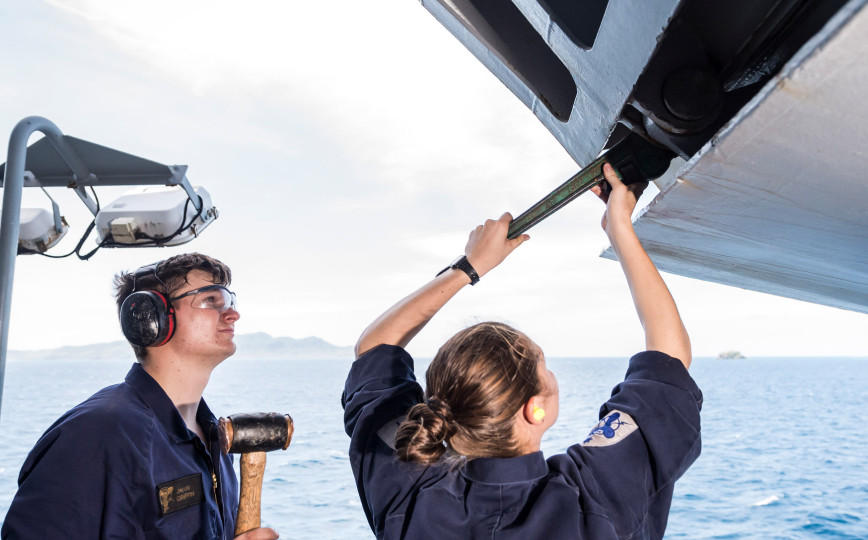
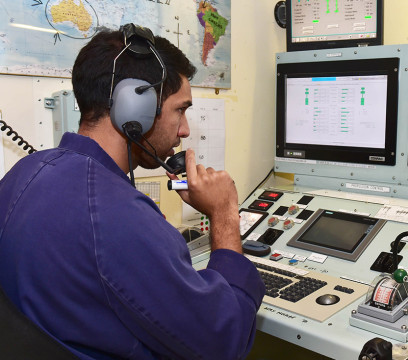
Marine Technicians are responsible for the operation and maintenance of the ship’s engine and drive systems, power generation and distribution systems, as well as the auxiliary systems and habitability equipment which contribute to the ships ability to operate independently.
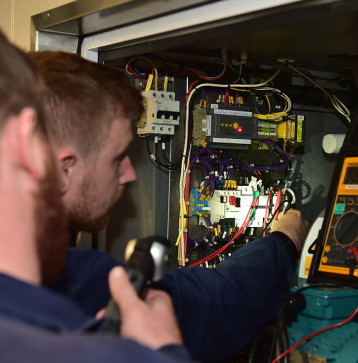
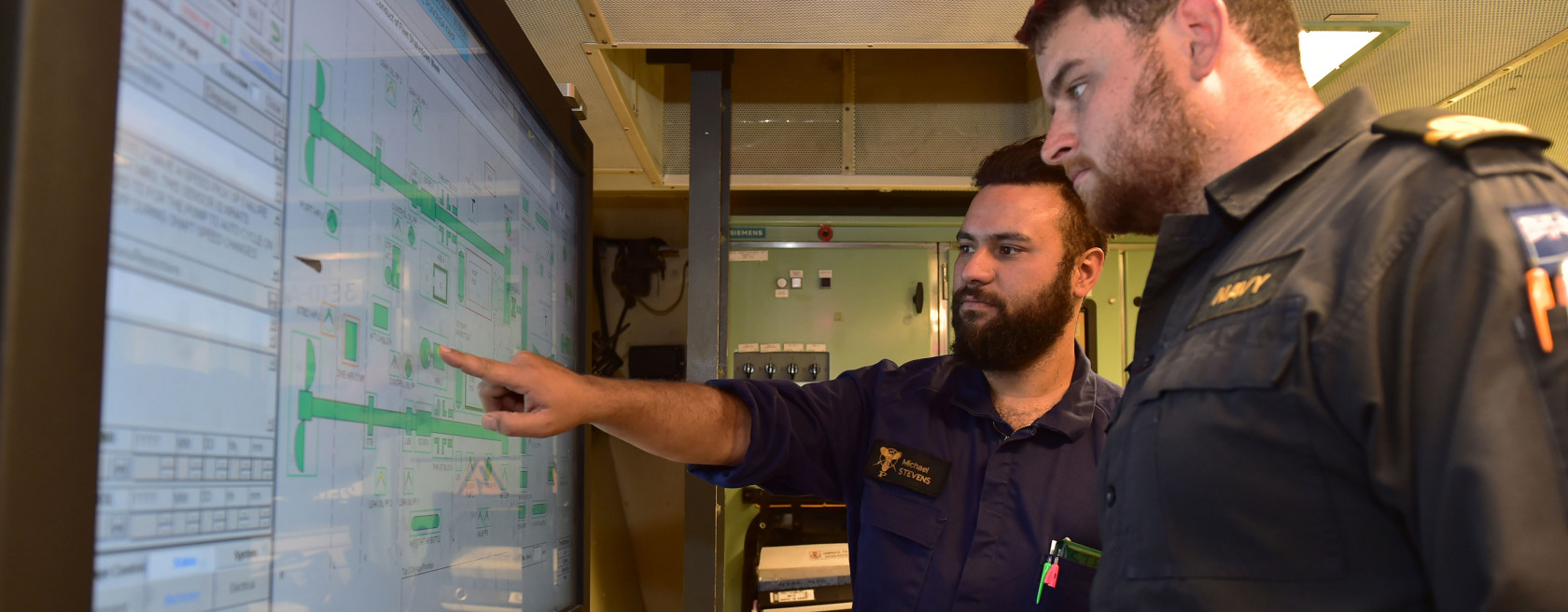
As modern warships contain increasingly sophisticated technology, you will learn to operate and maintain a wide range of high-performance equipment including: diesel engines, gas turbines, electrical generation and power distribution systems, hydraulic and pneumatic systems, refrigeration and air conditioning plants, and bulk liquid storage and conditioning equipment.
To best deal with the diverse range of machinery and equipment in our naval fleet, you will complete a short course in your chosen specialisation before being assigned to a ship at sea to practically consolidate your learning. You will quickly become part of a motivated, dedicated and highly professional team.
Job on base
Working ashore not only provides a break from life at sea, but also provide an opportunity for you to gain further training and experience. You will be assigned to one of the various maintenance departments or the Marine Engineering School for your own professional development and/or to support the learning of engineering students junior to you.
Job on deployment
Whilst on a ship, it is your responsibility to operate and maintain the ship's propulsion, auxiliary, and habitability systems, to ensure the ship remains fully operational. Ships at sea run 24 hours a day, so Marine Technicians may be required to work in shifts or be on call to monitor the ship's machinery or provide engineering services.
Like everyone else on board, you will participate in general shipboard duties and activities such as boat launch/recovery, leaving or bringing a ship to wharf, crane operations, assisting helicopter landings, ship security or practising emergency responses to fires, flooding or machinery breakdowns.
While deployed there are always excellent opportunities to experience different ports and environments within both New Zealand and overseas. Imagine the delights in cities of the Pacific Rim and beyond!
For anyone that is considering being an MT – give it a go. It’s a fantastic opportunity, you get a great trade out of it and you get to travel the world.
Michael O'Connell

Career progression and training
Career Progression
Basic Training
Job Training
Specialist Training
Your hard work, experience and training accomplishments as a Marine Technician are rewarded with civilian qualifications alongside promotions in rank and salary. You join the Navy as an Ordinary Rate completing Basic Training and Able Technician Training. After this specialist course you will fill positions on Naval Ships to consolidate what you have learnt through on-the-job training. As your skills and experience increase, you will be selected to complete your Advanced Technician and leadership Training before being recommended for promotion to Leading Hand, usually after four years of service.
Upon enlistment into the Navy you’ll be posted to Devonport Navy base in Auckland. Here you will do 16 weeks of basic military training to find out if you’ve got what it takes to be in the Navy, and learn various subjects including:
- Teamwork and support
- Naval history and customs
- Drill and parades
- Core mariner skills and weapons training
- First aid and firefighting
- Physical fitness
- Self-discipline
Following Basic Training, you will complete Able Technician training, also at Devonport Naval Base.
ABLE TECHNICIAN TRAINING
(46 weeks) Location: Devonport Naval Base (Auckland)
Subjects include:
- Electro-technology
- Safe Technician
- Workshop safety and skills via Manukau Institute of technology (MIT)
- Able Technician Common training
- Height safety operator
- Confined spaces operator
- Naval safety systems
- Power and distribution systems
Following this course you will be categorised as either a Propulsion Specialist or an Electrical Specialist depending on the best match for your skills, personal preference and spaces available, then complete 5 weeks of ‘streamed training.’
MARINE ENGINEERING COURSE
(5 weeks) Provides an introduction to marine and electrical engineering systems including propulsion and transmission systems, auxiliary systems, and habitability systems.
Don’t think your learning is limited to the classroom! You will spend the next two years at sea and ashore gaining machinery operating and maintenance experience.
QUALIFICATIONS EARNED
Throughout your studies, you'll have the opportunity to achieve industry-recognised trade qualifications such as the NZ Certificate (Level 3) in Electro-technology and an Electrical Service Technician (EST) licence after 18 months of practical service.
Once you’ve completed the advanced Electrical or Propulsion Course, you’ll gain a NZ Certificate (Level 4) in either:
- Refrigeration and Air Conditioning (Trade);
- Mechanical Engineering (Maintenance Engineering) for Propulsion Specialists;
- Mechanical Engineering (Electrical Engineering) for Electrical Specialists and licensing through the Electrical Workers Registration Board as a registered Electrician;
The Navy meets all costs of this training, which is usually concluded within the first four years of a Marine Technician’s career. Travel and earn as you gain your qualification without the student loan!
As your career progresses, further opportunities for specialist training and higher education becomes available to you. This may include subsequent Level 4 qualifications or a Level 6 Diploma during the Petty Officer course and pathways toward achievement of Bachelor’s and Master’s degrees.
The Royal New Zealand Navy values diversity of knowledge and skills amongst its engineers and is very supportive of your continued professional development.
Salary and benefits
Careers in the Navy are well-rewarded, as well as being diverse and exciting. As you become more experienced and move up through the ranks, gaining additional skills and qualifications, you will see your salary rise accordingly.
$50,597
Under Initial Training
$64,177
Starting Trade Training
$129,061
Future Potential Earnings
Figures updated on July 1st 2023
A great start to a promising engineering career
Back-to-back maintainer
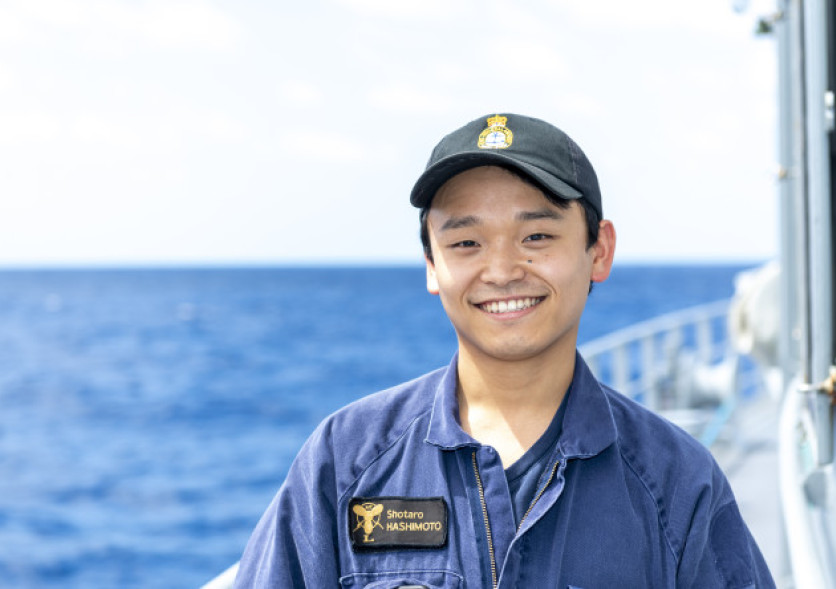
Leading Marine Technician (Electrical) Shotaro Hashimoto is a very busy sailor on board a very busy vessel. As the ship's Electrical Maintainer, Shotaro's day-to-day work at sea is usually around fault-finding and carrying out rectifications, although remember that the downside is that at sea, resources are limited!
Benefits and allowances
Earn a competitive salary while training or learning your trade, along with additional allowances for time spent in the field, at sea, overseas, or deployed on operations.
In addition to salary and allowances, other benefits of joining the New Zealand Defence Force include:
Access to your Service marae or tūrangawaewae
Sponsored tertiary study programmes at all levels
Free access to gyms and swimming pools on camp and bases
Opportunities to travel
Free and subsidised medical and dental care
Subsidised food and accomodation on camps and bases
Free and subsidised insurance cover
Help to buy a home and save for retirement
Entry requirements
Basics
Education
Fitness and Medical
Citizenship
Period of Service
- Be a minimum of 17 years of age upon entry.
- Be free of any criminal convictions.
NCEA Level 2 certificate.
Find out more about the NCEA levels and certificate requirements
Please note, the academic courses and unit standards that you will be required to pass as a Marine Technician are largely physics/maths based and consist of Level 2 to Level 4 Unit Standards. Hence, if you have completed maths and some physics as part of your science credits (mechanics, electricity etc.), this will go a long way to help with your academic studies in the Navy.
- You must be medically fit for service.
- You must meet the minimum entry fitness standards.
- Colour perception requirements may apply.
There are strict citizenship and security requirements to gain the required security clearance required for this trade. You must be free of any criminal convictions.
Find out if you’re eligible here.
On attainment of your Level 4 qualification there may be a Return of Service Obligation (RoSO) of up to 18 months, in acknowledgement of the time and expense that has been invested in your training.
Please contact our 0800 number or talk to your Candidate Experience Facilitator for more information.
Ready to start your Navy career?
Other jobs you might like
You can also browse jobs by specialisation to narrow down your search.